
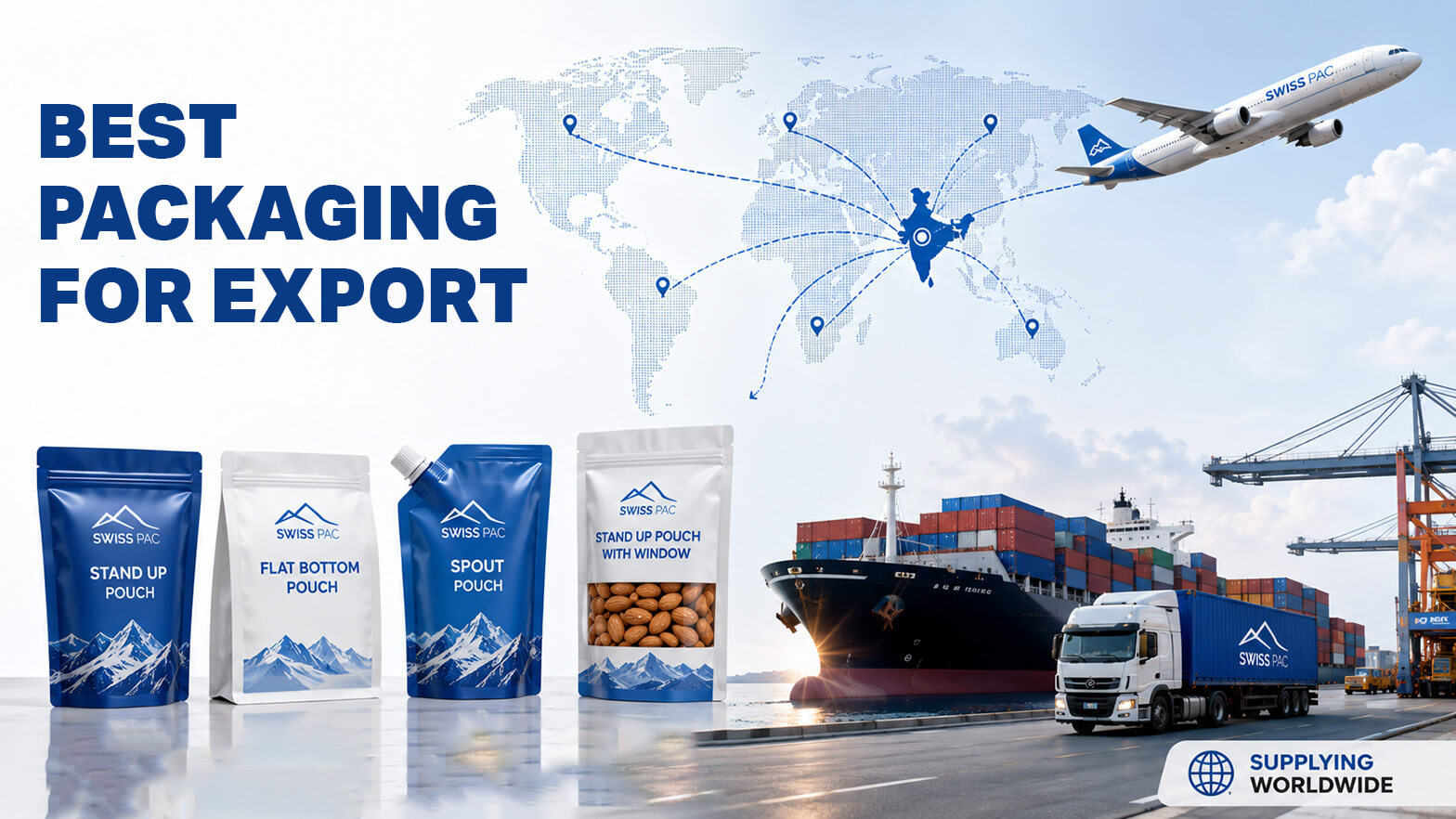
Domestic packaging and export packaging are not the same job. A pouch that performs perfectly on Indian retail shelves can fail completely inside a shipping container bound for Dubai, Rotterdam, or New York. The product has not changed. The conditions it travels through have.
India is one of the world’s largest exporters of food and consumer goods, sending spices, rice, flour, snacks, tea, coffee, supplements, and more to markets across the Gulf, Europe, the UK, North America, and Southeast Asia. Getting the product to market is one challenge. Getting it there in the same condition it left is another, and packaging is where that second challenge is either solved or ignored.
This guide covers what actually happens to products in export transit, how different markets require different packaging specifications, and which flexible packaging formats are best suited for the demands of international shipment.
1. Why export transit is harder on packaging than domestic distribution
45-60
days is a typical sea freight transit time from Indian ports to Northern Europe or the US East Coast. A product packed for a 7-day domestic journey is not the same as one packed for two months at sea.
When a product ships domestically, it spends a few days in a truck, a few days in a warehouse, and lands on a shelf within a couple of weeks. The packaging needs to survive that. It is a manageable challenge.
Export via sea freight is a completely different environment. A container leaving Mumbai or Chennai for Rotterdam passes through the Arabian Sea, the Red Sea or the Cape of Good Hope, and the Atlantic. Temperature inside a container can swing from below freezing on deck at night to over 50 degrees Celsius under a tropical sun during the day. Humidity builds and falls. The product is stacked under weight. It may sit in a customs holding facility for days or weeks before it is cleared. By the time it reaches a retail buyer, it has been through conditions that a domestic product will never see.
Air freight is faster but brings its own issues. Rapid pressurisation and depressurisation puts stress on seals. Temperature drops quickly in aircraft holds. Condensation can form on pouches as cargo moves from warm ground conditions to cold altitude within minutes.
The packaging you choose for export needs to account for all of this before the product ever leaves the factory.
2. The five things that damage products in a shipping container
Problem 01
Container rain and condensation
Temperature swings inside a sealed container cause moisture in the air to condense and drip from the container ceiling onto cargo below. This is called container rain. Products in pouches with poor WVTR absorb that moisture through the film. Seals weaken. Powders clump. Labels delaminate. A high-barrier laminate with low WVTR is the first line of defence.
Problem 02
Oxygen ingress over a long journey
A pouch that passes a basic oxygen barrier test for 30-day domestic shelf life may not hold up for 90 days in transit plus retail shelf time after arrival. Coffee, spices, nuts, protein powder, and any product with fat content will oxidise and go rancid if the OTR of the film is not specified for the total expected product life. For Gulf and European markets, this is a common cause of rejection at port.
Problem 03
Heat damage and laminate delamination
Containers in tropical sea lanes or sitting on port tarmac in summer can reach internal temperatures of 50 to 60 degrees Celsius. At those temperatures, low-grade lamination adhesives soften and layers can separate. The barrier layer splits from the outer print layer, the pouch loses structural integrity, and the product inside is effectively unprotected. Export-grade laminates use adhesive systems rated for high-temperature environments.
Problem 04
Seal failure under stack pressure
Products packed for export are stacked higher and loaded more densely than in domestic distribution. Bottom cartons in a pallet can be under significant compressive pressure for weeks. Pouches with inadequate seal strength can fail under sustained load. Seal strength for export packaging should be tested to a higher specification than domestic equivalents.
Problem 05
Customs hold and extended storage
Products entering the EU, UK, USA, or Gulf markets may be held at customs for days or weeks. During that time the product sits in a port warehouse, not a climate-controlled facility. Packaging specified for a 12-month shelf life needs adequate margin after 2 months of transit and 3 weeks of customs hold before retail shelf life even begins.
3. What different export markets actually require
Each major export destination for Indian goods has its own compliance requirements. Getting these wrong means rejection at the border, return of the shipment, and in some cases a trading ban. Here is a market-by-market overview.
| Market | Key packaging and compliance requirements |
|---|---|
| Gulf / GCC | Halal certification mandatory. Arabic labelling required. Production and expiry dates must be printed or embossed directly on primary packaging, not stickers. Net weight in metric units. GSO standards apply for food-contact plastic materials. The Gulf is India’s largest food export destination and one of the strictest on labelling compliance. |
| European Union | EU Regulation 1935/2004 governs all food-contact materials: the inner sealant layer must comply. Full ingredient traceability required. GMO content declared above 0.9 percent. Nutritional information per 100g mandatory. Specific rules apply to adhesive systems used in laminate construction. |
| United Kingdom | Post-Brexit UK operates its own food contact material regulations, broadly mirroring EU but diverging. English-language labelling mandatory. Date marks in UK format. Halal certification increasingly expected by UK retailers for Muslim consumer markets. |
| USA / Canada | FDA facility registration required before food arrives. All food-contact materials must comply with FDA 21 CFR. Nutrition facts panel follows FDA format. Net weight in both metric and imperial units. Canada requires bilingual English and French labelling for retail products. |
| Southeast Asia | Requirements vary by country. Singapore aligns closely with international standards. Malaysia and Indonesia require Halal certification. Local language labelling may be required at retail. Strong growth market for Indian spices, ready meals, and health food categories. |
4. Which packaging formats hold up in export conditions
Not every flexible packaging format performs equally in international freight. Here is how the main formats map to export product categories and shelf life requirements.
Stand-up pouches with foil laminate
Four-layer foil laminate provides OTR and WVTR performance for 12 to 18 month export shelf lives. Used for spices, tea, coffee, nuts, snacks, and dry food. Specify export-grade adhesive for heat resistance.
Flat bottom pouches
Preferred by specialty food exporters targeting premium Gulf and European retail. Strong shelf presence internationally. Available in full foil and metallised structures for export barrier requirements.
Retort pouches
Sterilised at high temperature after filling. Long ambient shelf life without refrigeration. Used for ready meals, curry pastes, and wet pet food. A practical alternative to cans for markets where cold chain is unreliable.
Woven PP bags with inner liner
For bulk export of rice, flour, spices, and seeds. Outer woven PP provides physical strength and stack resistance. Inner PE or foil liner controls moisture ingress across long sea freight journeys.
Vacuum pouches
Remove oxygen entirely before sealing. Dramatically extends shelf life for coffee, spices, rice, and dry products where residual oxygen is the primary spoilage risk during long sea freight transit.
Coffee bags with degassing valve
One way valve lets CO2 out without letting oxygen in. Critical when roast-to-consumer time is 6 to 10 weeks by sea. Without it, the bag balloons and coffee oxidises significantly faster.
From Swisspac
Export packaging specifications are different from domestic ones and the difference is not cosmetic. When we work with Indian brands exporting to the Gulf or Europe, the laminate structure, adhesive system, seal strength specification, and barrier targets are all set higher than for the same product in domestic retail. The shelf life the packaging must guarantee is transit time plus customs hold plus retail time, calculated from the date of packing. That total number is what drives the spec.
5. Labelling requirements by market
A product rejected at customs for a labelling error is a complete shipment loss. This table covers the non-negotiable requirements for each major export destination from India.
| Requirement | Gulf / GCC | EU | UK | USA / Canada | India (FSSAI) |
|---|---|---|---|---|---|
| Language | Arabic + English | Local EU language | English | English (+ French for Canada) | English or Hindi |
| Date marking | Printed/embossed only. No stickers. | Best before or use by | UK date format | Best by / use by | Mfg + expiry date |
| Halal mark | Mandatory | Optional | Retailer driven | Optional | If claimed |
| Nutrition panel | GCC format | Per 100g, EU format | Per 100g, UK format | FDA Nutrition Facts format | FSSAI format |
| Net weight | Metric | Metric | Metric | Metric + imperial | Metric |
| Origin | Made in India | Made in India | Made in India | Made in India | FSSAI licence no. |
| Food contact compliance | GSO standards | EU 1935/2004 | UK FCM regs | FDA 21 CFR | FSSAI Packaging Regs 2018 |
Important: Design your artwork for the correct destination market format before plates or print cylinders are made. Changing labelling after artwork approval means reprinting, which is one of the most avoidable costs in export packaging.
6. How Swisspac can help you
Export packaging is not a decision to make under time pressure or on the basis of the cheapest quote. It is a technical specification that determines whether your product arrives in sellable condition, clears customs without issue, and earns the shelf life your retail buyer is expecting.
Right laminate for your route
Swisspac specifies laminate OTR, WVTR, and adhesive systems against your actual transit conditions and total shelf life target, not a generic domestic standard.
Compliance documentation
Food contact compliance certificates for FDA 21 CFR, EU Regulation 1935/2004, and Gulf GSO standards are available for all export-grade structures.
Export-ready from day one
From seal strength to Halal-compatible materials and artwork guidance for destination market labelling, the full specification is handled before production begins.
READY TO EXPORT?
Share your product type, destination market, and shelf life target with the Swisspac team. You will get a laminate recommendation, barrier specification, and compliance overview for your specific route, without a sales pitch.