
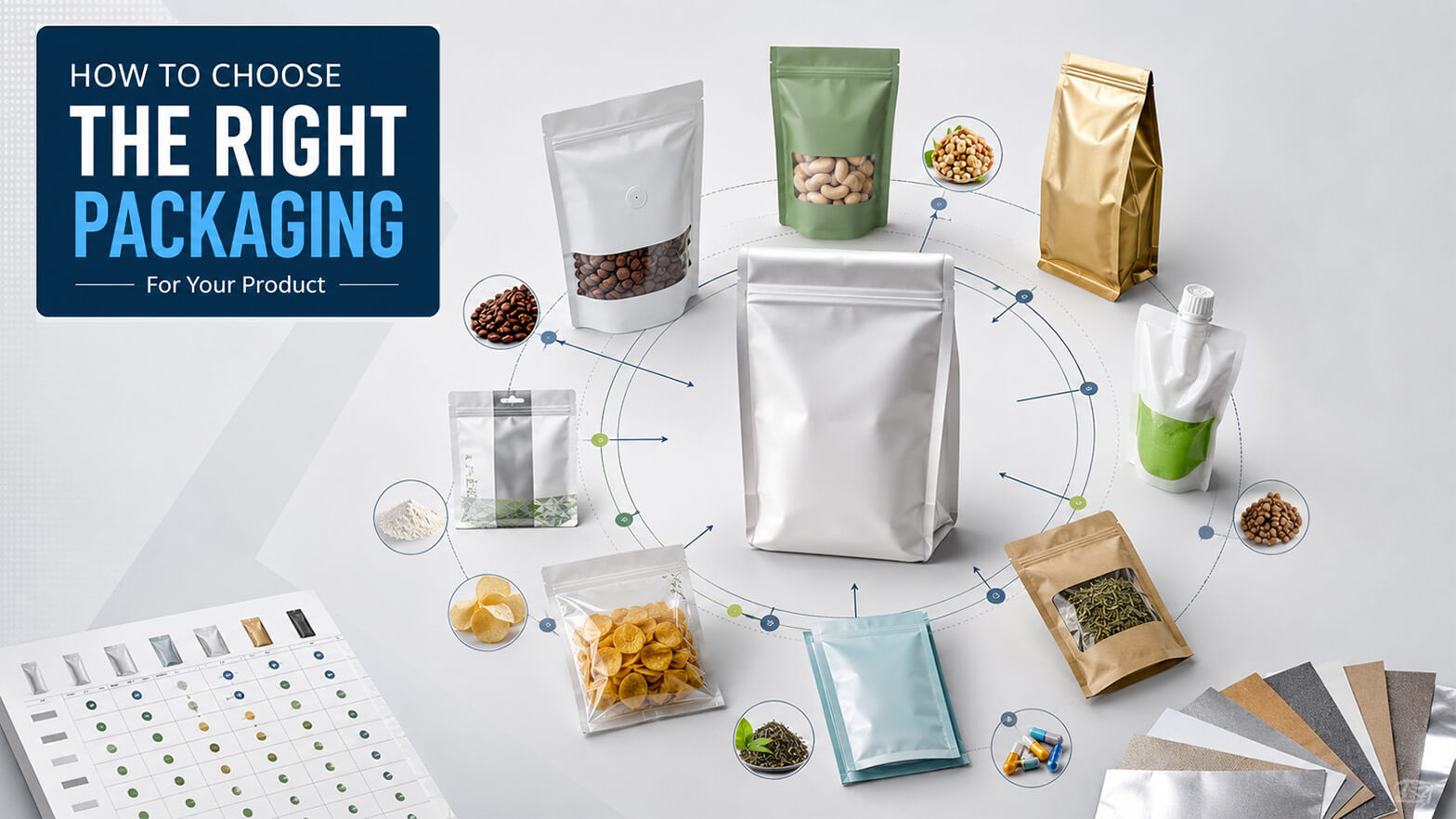
Your packaging is doing one of two things: protecting your product or slowly destroying it. Most brands do not find out which one until a customer complains, a distributor returns a pallet, or a shelf-life test fails six months in.
This guide covers everything you need to make a confident packaging decision: the problems that kill products in transit, the numbers that tell you whether a film will actually work, how different formats solve different problems, and the questions that separate a real manufacturing partner from a catalogue supplier
1. Why packaging fails and what it costs
30-40%
of food loss in supply chains is linked to inadequate packaging, according to the Institute of Food Technologists. Not bad product. Not poor storage. The packaging its
Most brands spend months developing a product and hours choosing the packaging. The result is that packaging decisions often come down to price and lead time, with nobody walking through what the film actually needs to do for that specific product.
When packaging fails it rarely fails visibly at the point of packing. It fails four months into a six-month shelf life, at a distributor’s warehouse, under a retailer’s store lighting, or in a customer’s hands. By that point the cost is not just the returned stock. It is the listing, the relationship, and the next order
2. The four threats every packaged product faces
Understanding what damages products inside packaging is the starting point for every laminate decision. There are four causes behind the majority of product failures in flexible packaging.
THREAT 01
Oxygen ingress
Oxygen causes oxidative rancidity in products with any fat content: coffee, nuts, protein powder, snacks, olive oil, and spice blends. It fuels microbial growth once residual levels inside a sealed pack exceed roughly 0.5 to 1 percent. It also degrades vitamins A, C, and E faster than most brands expect. A bag of freshly roasted coffee can taste flat within days if the film barrier is inadequate, well before any visible sign of spoilage.
THREAT 02
Moisture moving the wrong way
Moisture damage runs in both directions and both matter. Ingress, meaning external humidity entering the package, causes powders to clump, spices to cake, baked goods to soften, and pharmaceutical actives to chemically degrade. Egress, meaning moisture leaving the product, causes fresh goods to dry out and lose weight during transit. Protein powder that has gone solid, tea bags that taste thin, and flour that packs into lumps are all moisture problems that a correctly specified film would have prevented.
THREAT 03
Light degradation
Light is the threat most brands forget because the product looks fine on the outside while degrading inside. UV and visible light accelerate oxidative reactions in oils, fats, and natural pigments. Vitamins B2, A, and D are especially sensitive. Dairy products and supplements in transparent packaging can lose meaningful potency from ambient store exposure alone. For meat products, photodegradation produces colour changes that trigger consumer rejection even when the product is microbiologically sound.
THREAT 04
Seal failure
Packaging engineers will tell you seal failure is more common in the field than film failure. A pouch built from excellent laminate will still leak if the seal is poorly formed, and a leak does not have to be visible to compromise the product. Heat sealing requires the right balance of temperature, pressure, and dwell time. Too low and you get incomplete fusion. Too high and you degrade the film at the seal edge. Contamination from product residue on the seal band is the most common real-world cause, and it is a significant issue for protein powders, spices, and granola
3. OTR and WVTR: the two numbers that actually matter
Every packaging film has measurable barrier performance. Two figures tell you more about whether a film will actually protect your product than any product description or supplier assurance. Ask for both in writing before you commit to a structure.
Below 1.0 cc/m2/day
For most shelf-stable foods. Below 0.1 for coffee, supplements, and anything genuinely oxygen-sensitive. Reaching 0.1 requires aluminium foil or high-barrier metallised film.WVTR WATER VAPOUR TRANSMISSION RATE
Lower = better barrier
Measured in g/m2/day. Thresholds vary by product. Dried herbs and pharmaceuticals need very low WVTR. Always confirm the figure for your specific application.
A standard two-layer BOPP and PE film, common in budget packaging, does not come close to the thresholds most food and supplement products require. Adding a layer of EVOH, aluminium foil, or metallised PET changes the OTR dramatically. These are not premium options reserved for large brands. They are engineering decisions that determine whether your product survives its intended shelf life.
FROM SWISSPAC
Every custom pouch project starts with questions about product type, target shelf life, storage conditions, and distribution route. Those answers determine the laminate. A direct-to-consumer coffee brand targeting a 12-month shelf life needs a completely different structure than a bakery brand supplying local retail on a four-week cycle. There is no default correct answer: the spec follows the product.
4. Which packaging format solves which problem
Flexible packaging is not one product. The format, the laminate, and the closure each play a different role. Here is how the main formats map to real product and shelf life needs.
Stand-up pouches
Versatile retail format. Available in foil, metallised, kraft, and clear-window structures. Used for coffee, tea, protein powder, pet food, spices, nuts, and snacks.
Flat bottom pouches
Wider base for a stable, premium shelf presence. Preferred by specialty coffee, tea, and supplement brands wanting strong retail impact with full barrier performance. swisspac.com/flat-bottom/Coffee bags with valve
One-way degassing valve lets CO2 out without letting oxygen in. Essential for freshly roasted coffee. Without it, the bag balloons and coffee goes stale far faster.
Spout pouches
Designed for liquids: sauces, ketchup, beverages, baby food, liquid supplements. Resealable, lightweight, and cheaper to ship than glass or rigid plastic. swisspac.com/spout-pouches/Retort pouches
Withstand high-temperature sterilisation. Used for ready meals, wet pet food, and products needing long ambient shelf life without refrigeration swisspac.com/retort-pouches/Woven PP bags
Heavy-duty format for bulk products: rice, flour, fertiliser, seeds, animal feed. High tensile strength with inner liner options for moisture protection. swisspac.com/woven-pp-bags/Child resistant packaging
Required for cannabis, pharmaceuticals, and certain chemicals. Meets EN 14375 and ASTM D3475. Available in compliant pouch and bag formats.
Shrink sleeve labels
Full 360-degree print coverage for bottles, jars, and containers. No adhesive required. Includes tamper-evidence band options.
5. Sustainability: what is actually possible right now
Whether a pouch is recyclable depends on what it is made of and what infrastructure exists where your customers actually live. Vague sustainability claims without material data are not useful for making real decisions.
Multi-layer foil laminates deliver the best barrier performance but are generally not recyclable through standard household collection. The different layers cannot be separated at conventional facilities. The industry is working on alternatives across several directions:
Mono-material PE structures build the entire pouch from compatible polyethylene layers, making them recyclable through PE film drop-off points at many grocery retailers. Barrier performance has improved significantly but still falls short of foil for the most demanding applications.
Post-consumer recycled content (PCR) film incorporates material recovered from used plastics back into new packaging. Swisspac offers PCR-content and sustainable material options for brands building circular economy commitments into their supply chain.
Compostable PLA-based films require industrial composting conditions to break down within reasonable timeframes. In household compost or landfill, they behave similarly to conventional plastics. This matters when making claims to consumers.